
Women on the Front Line
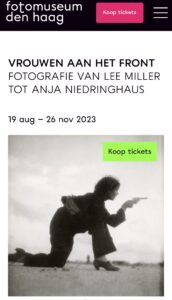 This is my final blog post about the Women on the Front Line exhibition that I visited at the Fotomuseum in The Hague. Even before delving deeper into the lives and work of these female war photographers, I was deeply impressed by their photographs. Having delved deeper into their lives and work, my admiration has only grown. What drove these women to capture the suffering of war so vividly?
Anja Niedringhaus
This blog post is about Anja Niedringhaus, a photographer whose work I had never seen before. Although her name was new to me, her work stayed with me. The more I read about her, the stronger my feeling became that there was an enormous drive behind her images. I began to delve into her life and background, and what I discovered, I share below.
The beginning
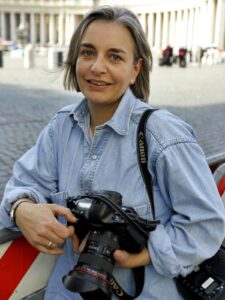 Anja Niedringhaus was born on 12 October 1965 in Höxter, Germany. She developed a fascination with photography at an early age. A friend of her parents who was a photographer for a local newspaper regularly took her out on assignments. She started experimenting with her grandfather’s camera herself. She also spent all her savings on books about photography and film, as if she wanted not just to look, but to understand too. What began as curiosity soon grew into something more serious. She contributed to the school newspaper and, at the age of sixteen, she took her first professional steps as a freelance photographer at the Neue Westfälische. Remarkably, she had such a clear sense of direction from such an early age.
After secondary school, she travelled to India, where she worked for the charity Kindernothilfe. Perhaps that was the moment when her horizons truly broadened, when she witnessed first-hand just how vast and unequal the world can be.
Back in Germany, she studied German literature, philosophy, and journalism at the University of Göttingen while writing for and taking photographs for the Göttinger Tageblatt.
Breakthrough
 Her breakthrough came in the early 1990s. It was her photographs of the fall of the Berlin Wall that led her to the European Pressphoto Agency (EPA), where she became the first woman to be offered a permanent position. This was perhaps the turning point, revealing just how determined she was to find her place in a world that was not naturally open to her.
Former Yugoslavia
After much insistence, she was finally given the opportunity to be sent to Bosnia in 1992, when war had broken out. What was intended to be a stay of a few weeks turned into five years. She found herself in a world she barely knew, with little experience of war zones. Yet she managed to settle in surprisingly quickly.
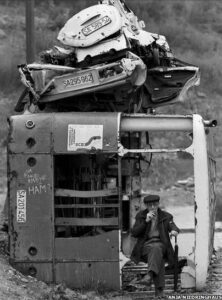 She developed rapidly, both amongst experienced photographers and in her own work. Her photographs were regularly published, demonstrating that she was finding her feet and knew exactly where to look. What she found was the harsh reality of war. It was a world where tension was ever-present and violence could erupt suddenly and without warning, often amidst everyday life. Nevertheless, ordinary life goes on, however fragile it may be. In those circumstances, she focused on what was happening around her. She photographed civilians forced to live with constant conflict and families trying to survive in almost unimaginable conditions. Her work reveals just how close war can be to people — and how, despite everything, they carry on.
The Associated Press
 She began working for the Associated Press, the world’s largest news agency, in 2002. Based in Geneva, she travelled to various conflict zones, including Israel, Palestine, Iraq, Afghanistan, Libya and Pakistan. What I hadn’t expected was that her work wasn’t confined to war zones. She also photographed major sporting events, which she clearly enjoyed. This variety reveals another side to her work — a world that seems lighter, yet which still requires the same level of alertness and concentration. According to her, she learnt an important lesson there: how to switch gears quickly with complete focus and commitment at the moment when everything comes together.
Iraq
 In 2004, she was one of the first female journalists to accompany the US armed forces as they advanced towards Fallujah, a stronghold of Iraqi insurgents. It was an extremely dangerous assignment, for both her and the soldiers she was travelling with. Conditions were harsh and casualties were high; many of the soldiers in her unit did not survive the mission.
Through her many assignments with the army, she gained an ever-deeper insight into life on the front line — into the exhaustion, uncertainty, and constant pressure under which the soldiers had to operate. What strikes me about her work is that she does not portray these experiences as tales of heroism. Rather than idealising the soldiers, she reveals their humanity: they are vulnerable, tired and often overwhelmed by what they are going through.
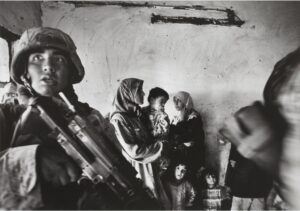 The front cover of the catalogue for the Women on the Front Line exhibition features a photograph of her taken during a house search in the Abu Ghraib district of Baghdad. What strikes me about the photograph is the palpable tension present on both sides, evident in both the heavily armed young Marine and the family being held at gunpoint. There seems to be just as much fear in the gaze of one as the other.
Afghanistan
During the most difficult years of the protracted war, she travelled there repeatedly, gaining an ever deeper insight into the lives of Afghans. In 2009, she started collaborating closely with Kathy Gannon, a Canadian journalist and Associated Press correspondent in Pakistan and Afghanistan who had an in-depth knowledge of the culture and politics of the entire region. Together, they became the first Western journalists to be granted permission to join the Afghan army.
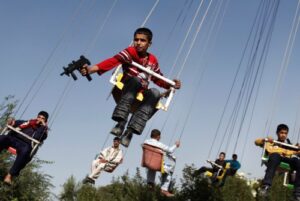 Her frequent returns to the country meant that her work there became increasingly in-depth. Her stays in crisis zones were never brief. In order to better understand the regional context and familiarise herself with the local culture, she kept returning time and again, particularly to Afghanistan.
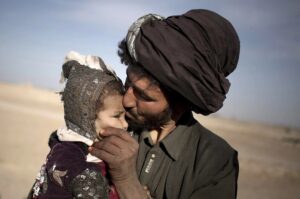 Reporting from this region gradually became an increasingly important part of her work, and she developed a personal connection to the place. She often emphasised the hospitality and warmth of the Afghan people, who became dear to her.
Injured
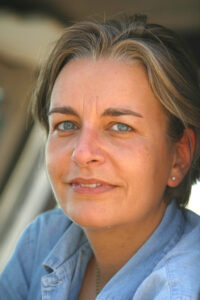 Anja Niedringhaus was seriously injured on several occasions while carrying out her work. It began in Sarajevo, where she was shot at by a sniper. Later, in Belgrade, she suffered a severe foot fracture when she was hit by a police car. She was hit by shrapnel in Kosovo and, in 1999, came under fire alongside a group of journalists when NATO aircraft accidentally bombed a border crossing between Albania and Kosovo. Danger continued to haunt her in the years that followed. In 2010, in Kandahar, she was hit by shrapnel again during a bombing raid. She always placed herself close to the front line and in the thick of events, with all the risks that entailed.
Killed
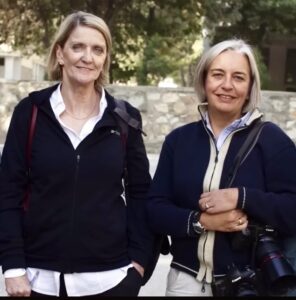 Anja Niedringhaus was killed on 4 April 2014 when she was shot dead in Afghanistan by an Afghan police officer. She and journalist Kathy Gannon had gone there to report on the elections and monitor the distribution of ballot boxes to remote areas. At the time, they were in a car within the secure compound of the Afghan security forces in Khost province. What should have been a relatively safe environment suddenly turned into a scene of violence. The policeman opened fire, possibly driven by a desire for personal revenge following the loss of family members in a NATO airstrike. Anja Niedringhaus died at the scene. Kathy Gannon was seriously injured but survived the attack.
It is almost inconceivable that someone who has endured so much danger should ultimately lose their life in this way — not on the front line, but in a place that should have offered protection. You can find an interview with Kathy Gannon and photographs taken by Anja Niedringhaus here. There is also a tribute to her in the German magazine Der Spiegel, which features an extensive overview of her photographic legacy.
Awards
Throughout her career, Anja Niedringhaus received numerous awards.
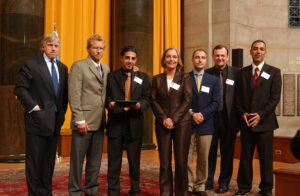 In 2005, she and her colleagues won the Pulitzer Prize for their reporting from Iraq, which recognised her standing within the field of international photojournalism.
 Also in 2005, she received the Courage in Journalism Award from the International Women’s Media Foundation.
Her work lives on, even after her death. The International Women’s Media Foundation established the Anja Niedringhaus Courage in Photojournalism Award to honour female photojournalists who demonstrate the same courage and dedication as she did.
Harvard University has also established a Nieman Fellowship in her name to support a visual journalist each year and keep her legacy alive.
Exhibitions
Anja Niedringhaus’s work has been exhibited worldwide in leading museums and galleries, including the Museum of Fine Arts in Houston and the Bronx Documentary Center. Her work was still on display at the latter institution in 2024. Her work can also be seen in Europe, with past exhibitions at the Museum of Modern Art in Frankfurt, C/O Berlin and the Käthe Kollwitz Museum in Cologne, as well as a forthcoming presentation at the Ludwig Galerie in Oberhausen. In her hometown of Höxter, the Forum Anja Niedringhaus has been established as a permanent home for her legacy, with regular exhibitions of her work. It is fitting that her images keep returning to the place where her story began.
Publications
In addition to her photographic work, Anja Niedringhaus left behind publications offering a deeper insight into her practice.
 In 2001, Fotografien was published by the Museum of Modern Art in Frankfurt.
  Ten years later came At War (Hatje Cantz), a compelling overview of twenty years of work in conflict zones, in which her work in Iraq features prominently.
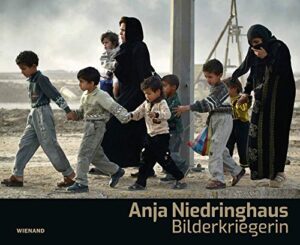
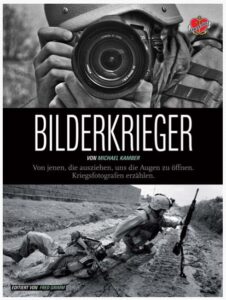 Her website also mentions Bilderkrieg/Photojournalists at War, a book in which 39 leading photojournalists reflect on their experiences during the Iraq War. Niedringhaus’s work is featured in a separate chapter, in which she shares her images and discusses the ethical dilemmas of war reporting and the complexity of working in a conflict zone.
Although she is often associated with her work in Afghanistan worldwide, this publication demonstrates the significance of her contribution to the visual representation of the war in Iraq.
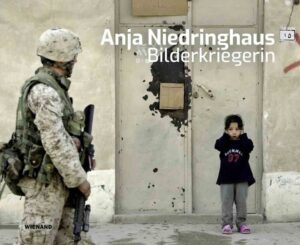 In addition, the catalogue Bilderkriegerin was published to accompany the 2019 exhibition at the Käthe Kollwitz Museum in Cologne. Her work was also included in the catalogue for the 2020 Fotomuseum Winterthur exhibition, Women War Photographers.
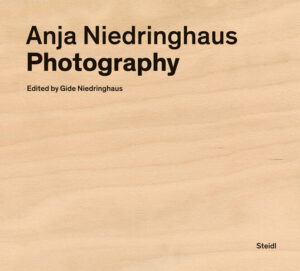 A comprehensive volume offering a broad overview of her work across different phases and contexts, Anja Niedringhaus Photography, will be published in May 2026. This special edition brings together seven volumes, offering a meticulous and tangible overview of her entire body of work.
Perspective and approach
When you spend some time looking at her work, you naturally start to wonder who she was behind the camera and how she went about her work. What is striking is that her vision has deepened over the years. Her images have become more direct and urgent. She described how she gradually learnt to read situations more quickly and interpret them more sharply — a skill that is increasingly evident in her work.
She sought out the fringes of extreme circumstances. Not for the sake of sensation, but because that was where her work flourished. In that context, she focused on what was happening before her: people at war, under tension and struggling to survive. What lingers is the intensity of her gaze — not just what she saw, but how close she dared to get to it.
Behind the Scenes
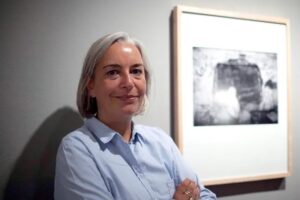 A sense of balance emerges in her work, revealing something of her personality, though this cannot be separated from the world in which she worked. Stories from her colleagues and her presence in the field reveal an unexpected lightness.
She had a booming laugh and a thick German accent, as well as an almost unshakeable decency that inspired confidence in everyone around her. At the same time, she was fiercely competitive yet exceptionally loyal. She fully shared the realities of life in the field — armoured cars, unheated rooms, long journeys and endless waiting times — with those around her. She often introduced young photographers to her perspective, capturing something essential through seemingly simple stories along the way.
Danger
Her light-heartedness existed within a reality in which the safety of journalists could never be guaranteed. Her work repeatedly placed her and her colleagues in situations where risks were present, even when they were not immediately apparent.
For journalists in conflict zones, danger is not an exception, but an ever-present part of the job. The line between observing and becoming part of the situation is fine, and a camera offers no protection — often quite the opposite.
In her case, this meant living a life of constant motion due to unpredictable circumstances. She worked in areas where tension could escalate in an instant, in situations where every assessment counted, and in moments where vigilance never wavered, even when things seemed quiet for a moment. Despite the risk and uncertainty, Anja Niedringhaus chose to be there.
Accessibility
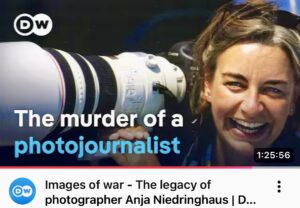 Her work remains accessible. Her photographs are displayed worldwide in museums, archives and publications, bearing witness to the situations in which she worked and her vision of the world. You can also view her work online, including in the YouTube documentary ‘Images of war – The legacy of photographer Anja Niedringhaus | DW Documentary’, which provides further insight into her work, travels and experiences in conflict zones, as well as the context in which it was created.
You can view 139 of Anja Niedringhaus’s photographs on the MUSEUM MMK FÜR MODERNE KUNST website, as well as on Der Spiegel’s website. Ten years after her death, AP Images honoured her on their website. There is also a tribute to Anja Niedringhaus titled ‘A life in Photos’ on the NBC News website. The International Women’s Media Foundation also honoured her ten years after her death on their website as well as the Deutsche Börse Photography Foundation.. You can also find her work on the World Press Photo website.
Her images continue to demand attention, encouraging us to look again and never forget.
Johanna, 21 April 2026
