
Introduction
 Before starting this new blog post, I reread my previous piece, ‘Looking without claiming’. A few weeks have passed since then, but my visit to gallery Noir Noir still feels like a massive liberation. It was there that I discovered I am simply allowed to look at art, and to find it beautiful or not, entirely without prejudice. But because it is simply in my nature to dig deeper, I cannot just leave it at that. I want to truly understand the world of Surinamese art.
Digging deep is something I have done my entire life. I was born in 1952, right in the middle of the post-war reconstruction period. At the time, the Netherlands was still strictly pillarized. My worldview, my language, and my social manners were largely determined by the specific societal pillar in which I grew up: a socially conscious working-class environment, as activist as it was religious. My personal challenge has always been to broaden my horizon. And that is exactly what I am doing once again regarding the art of African-Caribbean Dutch artists. I am intensely curious about what they create, and how their work was and is received within the Dutch art world.
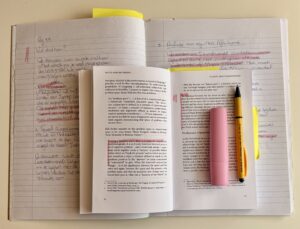
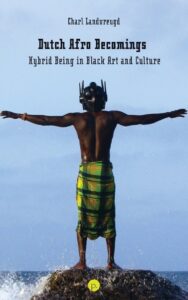 As a guide for my quest, I am using the book Dutch Afro Becomings: Hybrid Being in Black Art and Culture/ Charl Landvreugd (Punctum). This work is the commercial trade edition of his academic PhD thesis at the Royal College of Art in London (RCA), which originally appeared under the title Locating Afro artists as culturally native to the Dutch art world.
Because the book is written in English and has a dense academic foundation, it is a matter of translating it page by page. Sometimes, I really have to let a passage sink in before I grasp its exact essence.
Epistemological Thinking
 Why do I involve my own background in this? It comes down to a specific concept that Charl Landvreugd describes on pages 32 and 33: the ‘problem space’, in the chapter titled “Problem Spaces: Calling Forth a People-Yet-To-Come”. He borrows this concept from cultural theorists Stuart Hall and David Scott. Landvreugd quotes, among others, from a 2004 lecture by Stuart Hall: ‘Evoking a ‘problem space’, then, is to think of a conjuncture epistemologically’.
And that is where the first challenge began for me, because what does it mean to think through a situation ‘epistemologically’? In short, epistemology is the branch of philosophy concerned with the critical question: how do we know what we know? It is about how we arrive at our deeply ingrained frameworks of thought, and how history defines our playing field. That is why I involve my own upbringing in this search.
When I break down this complex concept, it unfolds into three distinct steps:
The time you live in determines the questions
Stuart Hall argues that every historical moment (the conjuncture) calls forth a specific set of cognitive, political—and artistic—questions that together create a ‘horizon’. This intellectual playing field is our ‘problem space’. An artist or thinker never stands isolated from their time. In my birth year of 1952, during the pillarized reconstruction, people simply could not ask the artistic questions of today; the social context had not yet produced those questions.
Time determines your future
 According to David Scott, our horizon develops within that problem space: the space within which we ‘think the present’. When times change, that horizon changes with it. What was once a ‘horizon of the future’ for a previous generation becomes a ‘past future’ (futures past) for the next. It is a horizon that we can no longer imagine, inhabit, or represent in the same way.
My horizon—the maximum of what I can see or hope for—is therefore bounded and shaped by the world of today. What was an unimaginable future in the 1960s or 1980s for African-Caribbean-Dutch artists has become their reality today. They, and I as well, can no longer look at it in the same way as back then.
Your answers are already partly predetermined
This is perhaps the most confronting part of the theory. Stuart Hall writes that while our actions are an answer to the questions of our time, we seem ‘constrained’ or ‘conscripted’ to give those specific answers.
In reality, I am not nearly as free in my thinking as I always thought. Society and politics conscript us to think in a certain direction. The era we live in forces us to occupy ourselves with very specific problems. Broadening my horizon means, in the context of this theory: learning to recognize the ‘problem space’ in which I myself was formed, in order to truly open myself up to the problem space and the horizon of another. This theoretical playing field is the foundation from which I try to look further.
What is Hybridity?
 Now that I understand, thanks to Landvreugd, Hall, and Scott, how the zeitgeist directs my gaze, I can transition to the core concept of the book: hybridity. I was looking for a way to make this tangible. Hybridity simply means ‘layeredness’ or ‘mixture’. It is the idea that an identity or an artwork does not consist of just one ‘pure’ culture, but is a dynamic fusion of different worlds.
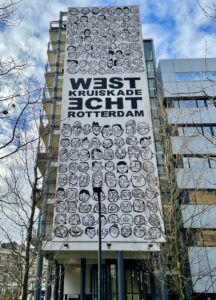
To me, this is not an abstract theory on paper, but a daily reality. I live in Rotterdam, one of the most multicultural cities in the Netherlands. It is a dynamic city with no fewer than 170 different nationalities, where over half of the inhabitants now have a migration background.
When I look around from this Rotterdam context, I see hybridity everywhere. Art too (think of street art, for instance) is not purely traditional African-Caribbean or Surinamese, nor is it purely traditional European or Dutch. It is precisely the energetic, blended form in between. Charl Landvreugd argues that we must stop putting art into such rigid boxes. ‘Hybrid looking’ means embracing that layeredness. You don’t search for what is ‘truly Dutch’ or ‘truly Surinamese’, but you look at the new, unique thing that has emerged from that encounter. It is looking without claiming, and accepting that something can possess multiple identities simultaneously.
Broadening the Horizon: A Look Ahead
 Deconstructing hybridity in this way helps me to better understand the dynamics of my own city. At the same time, through the process of translating and reading, I quickly noticed that the dialogue on hybridity is much larger than just Rotterdam or the Netherlands. Charl Landvreugd does not stand on an island; worldwide, thinkers and artists grapple with how to define their identity in a globalized world.
During my research, I stumbled upon fascinating, universal concepts and discussions that relate directly to this. I found myself immersed in the world of ‘Afropolitanism’ and read the sharp, critical texts of groundbreaking thinkers like Achille Mbembe and Binyavanga Wainaina, as well as the debates surrounding ‘Bye Bye Babar’. In their own unique ways, they show just how complex and layered modern African and diaspora identities truly are.
My notes on this are so extensive that it would be a shame to squeeze them in here at the very end. Therefore, I am saving these international thinkers for my next blog post. In that post, I will take you across geographical borders. In the blogs that follow, we will return to Charl Landvreugd and the Wakaman project, to see how he tries to translate all these global ideas specifically for our own African-Caribbean-Dutch community.
Ultimately, I hope to feel step-by-step more free in my approach to African-Caribbean and Surinamese art. No longer hesitant, but with an enriched gaze that can fully embrace the layeredness of art.
Would you like to cross the border with me? In my next blog post, I will dive into Afropolitanism and the refreshing ideas of Achille Mbembe.
Johanna
P.S. 1: Recommended Reading / Deep Dive
If you want to dive deeper into the academic foundations of this blog post, I highly recommend looking into these two essential works:
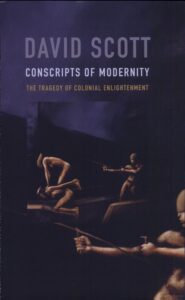
- David Scott – Conscripts of Modernity: The Tragedy of Colonial Enlightenment (2004)
- Why read this? This is the definitive theoretical cornerstone where David Scott fully develops and operationalizes the concept of the “problem space,” using it to critique and reframe postcolonial theory. This book serves as the direct academic source for the concept discussed above.
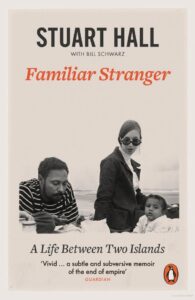
- Stuart Hall – Familiar Stranger: A Life Between Two Islands (2017)
- Why read this? In this posthumous autobiography, Stuart Hall beautifully applies the concept of the “problem space” directly to his own life and his transition from Jamaica to Great Britain.
P.S. 2: Artist Spotlight: Monsigneur Afrique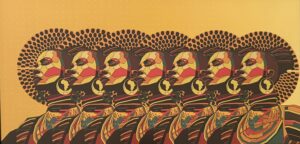 To bring the story of Galerie Noir Noir full circle, I want to highlight a work by Sigmar Vriesde (also known by his artistic pseudonym Monsigneur L’Afrique).
He is a prominent Dutch cultural entrepreneur, curator, art director, and diversity advisor based right here in Rotterdam. He dedicades himself to bridging the gap between marginalized creators and the established art world. Rather than acting solely as an art agent, he consciously operates as a cultural entrepreneur to maximize social and economic impact for his community.
- Galerie NOIR NOIR: He is the co-founder and curator of this creative hub located inside the Rotterdam Prins Alexander train station. The gallery focuses specifically on providing a stage for Afro-Caribbean art, culture, and identity.
- Stichting Afrique Magique: As co-founder and Creative Director of this foundation, he works tirelessly to illuminate underrepresented artistic perspectives.
