
Like paintings, I am inspired by poetry. The words, the rhythm comes to me like music. I love poems that mostly reflect something about personal growth and the meaning of life. I love the poems of Kipling, Tagore and Rumi.
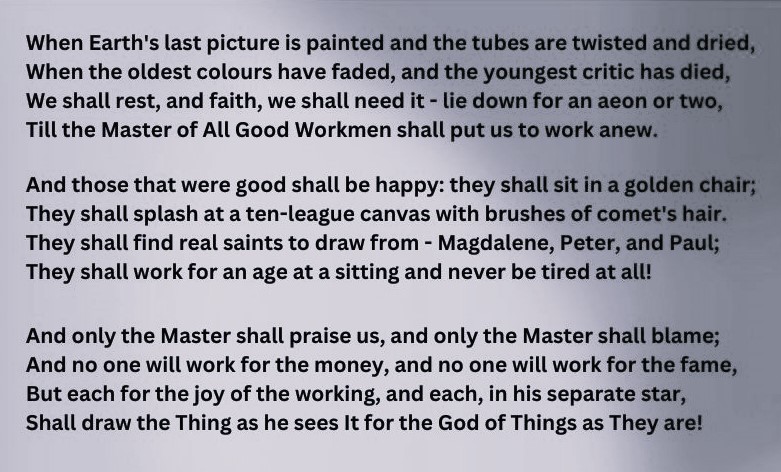
When I wanted to clean up some documents, I found a notebook with notes and saw how I tried to translate poems by Kipling in 1994. The challenge in this for me was to reflect the beauty of the words in my translation. Back then, we didn’t have Google Translate, DeepL or ChatGPT. Everything was done with a simple dictionary.
Rudyard Kipling (1865-1936)

Mewlana Jalaluddin Rumi (1207-1273)
Rumi was born in Balkh (Afghanistan). He later settled with his family in Konya, in present-day Turkey. His father was a preacher and religious scholar, and he introduced Rumi to Sufism. Rumi continued his theological education in Syria, where he studied the more traditional legal rules of Sunni Islam, and later returned to Konya as a teacher in a seminary. Shams-i-Tabriz became his mentor and had a lasting influence on Rumi’s religious practice and his poetry. He prompted Rumi to question his biblical upbringing, debated Koranic passages with him and emphasized the idea of devotion as finding unity with God.


Rumi is usually called a mystic, a saint, a Sufi, an enlightened man who wrote mystical poetry and stories. He was the leading figure of the Sufi movement in Konya. In particular, he philosophized about tolerance.
Among other things, he founded there the dance Mevlevi and the dervishes (Mevlevi), a Sufi order of religious dancers and musicians. In the dance, they rotate on their axis, meditating and invoking the name of God.
In a way, Rumi transcended his background.
Rabindranath Tagore (1861-1941)
Tagore was a famous poet, novelist and also practiced painting. He was the first Indian winner of the Nobel Prize in Literature in 1913. Tagore wrote the Indian and Bengali national anthems. He created a type of literary language closer to spoken Bengali than had ever been written before and also translated many of his works into English himself.
His work reflects great knowledge of both Western and Indian culture. He was innovative in the fields of education, music, religion and social reform. Writing on social and political issues, Tagore consciously sought a harmonious connection between Western and Eastern philosophies, religions and cultures in his worldviews. He had an important part in the liberation of India and his name is associated with that of Gandhi.
Tagore preached a joyful and loving merging with God in daily life. He believed that realizing oneness with the divine is the ultimate goal and fulfillment of humanity and that love is leading in it. In his view, humanity and divinity are not two different things. He saw them as two sides of the same coin. The purpose of religion, according to Tagore, is to activate the divinity that is latent in man and that religion is a unifying force and not a dividing force. From Stray Birds:


Poetry inspires me – Johanna