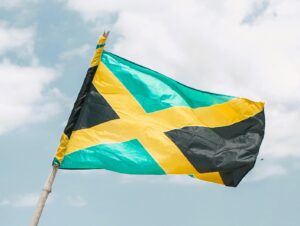
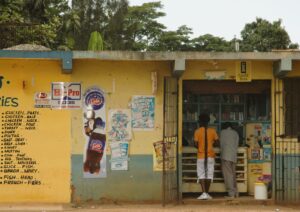
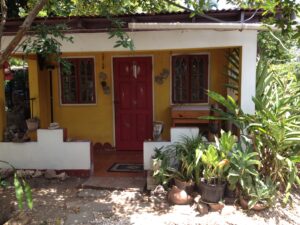
Through the music of Bob Marley and Peter Tosh, I longed for years to visit Jamaica once. I kept dreaming about it and in 2014 this dream came true. My stay in Jamaica was overwhelming and that was mainly because I had the opportunity to get to know Jamaicans up close. I did not stay in an ‘all inclusive’ accommodation but stayed in their homes. I saw not only the pretty picture but also the daily reality. Meanwhile, I have visited Jamaica 5 times.
Out of many one people
Jamaica is a former British colony. It is located in the Caribbean, south of Cuba. The population has a mixed composition. This is because the majority of the Jamaican population has African ancestors who were put to work as slaves. When slavery was abolished in 1834 (this was enshrined in The Slavery Abolition Act in 1833), the British recruited contract workers to replace the Africans, and these were contract workers from India and China. Jamaica was important as a sugar producer where people relied heavily on slavery for the economy.
Jamaica has a population of about 2.7 million. About as many Jamaicans live outside Jamaica. This is called the Jamaican diaspora. Most live in the United States, Canada and the United Kingdom.
Jamaica consists of 14 parishes which is something like a province in the Netherlands. Since independence in 1962, it has been a Constitutional Kingdom and is a parliamentary democracy with an elected prime minister.
Patois
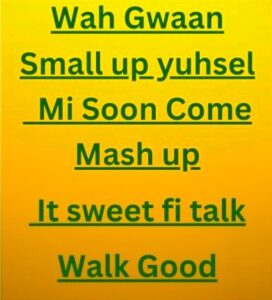
Jamaica’s official language is English. However, the majority of the population speaks Patois, a Creole language. This language originated because people from different parts of the world needed to be able to communicate with each other. Simplified English was the basis. Eventually, Patois gradually developed and is the daily language used by most Jamaicans. For me, however, Patois is too difficult to understand or speak.
Rastafari
Jamaica is where the Rastafari movement originated in the 1930s. The first Rastafari were descendants of slaves who strongly believed in returning to Africa. The Rastafari movement is a religion, a philosophy of life that originated in Africa (Ethiopia). It worships the Ethiopian emperor Haile Selassie I. Worldwide, it has about one million adherents. Through Jamaica and since the rise of Reggae music (through Bob Marley and the Wailers), the Rastafarian movement gained many followers. In Jamaica, the Rastafarian movement has become an important part of the identity of a significant portion of the population.
Reggae
It is the music of Bob Marley that made me dream about Jamaica where the lyrics of ‘Could you be loved’, ‘Don’t worry be happy’, ’Get up stand up’, ‘Exodus’, ‘No woman no cry’, among others, really appealed to me. This is because I was raised with a fighting spirit to enable values such as respect, equality for every human being. Jamaica has had a significant influence on music in the Western world. First there was Mento music, then Ska and Rocksteady and then there was Reggae. Since 2008, Reggae has been recognized by UNESCO as intangible cultural heritage.
Religion
I went to Jamaica thinking that everyone there was a Rastafari but I was badly mistaken. It turned out that about 66% of the population is Christian and belongs to the Anglican Church. There are also many Protestant denominations and Evangelical movements on the island. Religion is important in Jamaica, people live it very intensely, but on the other hand, they often live it in a very liberal way in everyday life.
Buddhism
As I wrote in my blog ‘Lack of time ‘ I was a long time member of the SGI, a Buddhist organization. There are also members of this organization in Jamaica and I lived with them. They were very welcoming and loving. It was special to experience how love and respect creates a bond. Even though we come from different worlds our goal is the same namely peace and happiness for everyone!
Crisscrossing the island
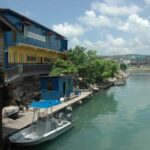
A lot of the roads in Jamaica are paved but about 1/3 are not. That takes some getting used to when you first encounter that. Many times in Jamaica I traveled around the island by car. I saw several places like Mandeville, Montego Bay, Ocho Rios, Spanish Town, Portmore, Port Antonio, Falmouth, Black River, Negril and of course the Blue Mountains and Kingston.
Jamaica’s railroads are among the oldest railroad lines outside of Europe and North America. Another 57 km of them are in use for bauxite transport. There are two international airports: the Norman Manley International Airport in Kingston and Sangster International Airport in Montego Bay. Most tourists arrive at the latter airport. There are also a number of small airports for domestic flights.
Because of its location in the Caribbean Sea, on the shipping route to the Panama Canal, Jamaica has a lot of container traffic. In Kingston and Montego Bay, there are many container terminals.
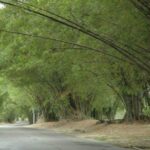
Nature in Jamaica is overwhelmingly beautiful.
Cost of living
The minimum wage in Jamaica is Jmd 13,000 per week which is equivalent to €80 per week. In comparison, the gross minimum wage in the Netherlands is € 460.40 per week.
There is an idea that living in Jamaica is much cheaper. That was also my idea but the reality is different. It is a wonderful country to live in if you have money but if you have a low income then the cost of living is considerable. This includes food, transport costs and general utilities such as internet, gas, electricity, heating. This costs about €95 per month. Health costs, for example a visit to a doctor can range between € 45 and € 90.
So far something about Jamaica. In another blog I want to write something about the beauty of Jamaica. Nature in Jamaica is so beautiful and that is hard to put into words.
I am grateful that I have been able to visit Jamaica several times.