
In May 2024, I visited the exhibition ‘A world in common’ at the Wereldmuseum in Rotterdam. I was surprised that there was so little publicity for this special exhibition, especially as it was put together in collaboration with the Tate Modern. Tate Modern showed the work of 36 artists, the Wereldmuseum of 22 artists.
The Wereldmuseum
The building that houses the Wereldmuseum dates from 1851. In 1885, it housed the

Start of the exhibition
In the first room I entered I saw large pictures of queens, kings and gods, followed by a room full of pictures of masks and Wura-Natasha Ogunji’s video performance ‘Will I still carry water when I am a dead woman’. The women in the performance wore masks and made noises. I felt like I was in unfamiliar territory and I was scared. Crazy, isn’t it, pretending to understand something about African art and culture? For me, it was intense to feel that I was reacting in this way as I entered (and was sucked into) an unfamiliar world. The creaking floors and mysterious atmosphere of the museum must have contributed to this.
Months after my visit, I used the catalogue to try to understand more about the background to the exhibition. I also collected information about the artists and watched interviews with them. I now understand better what inspires them and how the past still lingers. On reflection, I think the power/impact of the artworks (denouncing issues) made me feel overwhelmed and perhaps guilty.
As the exhibition features the work of 36 artists/photographers and I have collected a lot of information about them, this blog has become very extensive. For this reason, I have decided to split my blog about this exhibition into several blogs. Below is the result of my search for the content/meaning of the exhibition.
A world in common, contemporary African photography
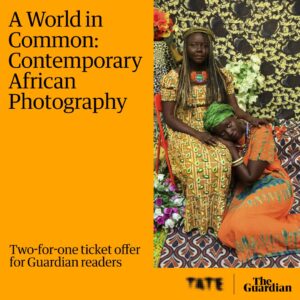

With their unique perspectives and experiences, the new generation of photographers is redefining the role of African photography in the global art discourse. Their work addresses social and political issues such as racial inequality and migration, exploring themes of gender and identity to represent marginalized communities. They are also committed to preserving the cultural and environmental heritage of their continent.
Innovation and experimentation also characterize their work, where the influence of the African diaspora cannot be denied. They use modern technology to innovate the aesthetics of their photography. In the end, they received recognition for these valuable, innovative contributions to photography.
A world in common, the director of programme
According to Caterine Wood Director of Programme of Tate Modern, the new generation photographers ‘seek to demonstrate that the continent of Africa has never been the single identity defined by its geographical borders and boundaries that has been historically imagined –and depicted. Rather it is part of a global human history rooted in unique forms of knowledge and experience.’ Further she states: ‘Challenging the boundaries between the historical events and present-day realities, artists explore the ways in which images have become unfixed from a linear timeline of history which implied that they represented a series of uncontested events.’
A world in common, the curator
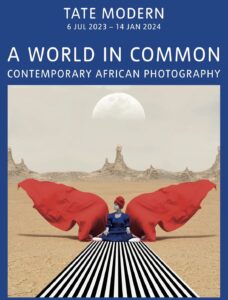

Osei Bonsu is the British-Ghanese curator of International Art at Tate Modern and is the curator of the exhibition. He states in his introduction to the exhibition that ‘the project is staged as a dialogue between contemporary photography and historical forms of image-making. It examines the forces of mobility and circulation upon which empires and territories were built, and consider the archive as a vast space of possibility in which alternative forms of storytelling are brought to life.’
What I understand from the above is that the artists in this exhibition are trying to break through the traditional idea that images and artworks should only show chronological moments of history. They challenge the linear perspective of cause and effect by presenting images that show new interpretations and alternative sides of reality. In this way, history is freed from a strict past. This gives the archive (the historical forms of image-making) a new role: it is not just a repository of the past, but becomes a dynamic space full of possibilities. New stories and perspectives come to life, offering innovative ways of looking at history.


As I see it, we are challenged to reflect on Africa’s role in our contemporary world, full of new opportunities and prospects for the future. Although the humanity of Africans has been denied in colonial times and beyond, it is now time to recognize that Africa’s history can no longer be seen as isolated or detached, but as an integral part of a global history of civilization, the common history of humanity: a world in common. My question, however, is who exactly is being addressed, who is being challenged? Is Achille Mbembe addressing a broad audience, including both Africans and the international community, including people outside Africa? Upon further reflection, I have come to the conclusion that he is inviting us all to rethink our perceptions of Africa’s role and history, and to see it not as something that concerns only Africans, but as something that concerns us all.
A world in common, the artists


According to Osei Bonsu, all artists are ‘artists actively contributing to a decolonial history that seeks to address the past while imagining a common future.’ He also wrote of them, ‘all the artists here use photography as a means of exploring a shared humanity.’
A world in common, the exhibition guide


‘Africa has always been the object of discourse by others. Now it is time to dream this utopia in Africa itself, to design Africa ourselves, to think and act for ourselves.’
I think this exhibition is showing that! The exhibition is divided into 3 main themes namely:
Identity and tradition
The first part of the exhibition focuses on the resilience of (ancient) African cultures and traditions. Despite centuries of struggle and change, these have endured. The artists featured here explore the ways in which identities have been shaped and influenced by history and traditions. There are three sub-themes, namely:
- Queens, Kings and Gods
- Spiritual Worlds
- Worrying the mask
Counter histories
The second part of the exhibition focuses on the role of photography during colonial rule. Photography was an important tool for the colonial powers to disseminate images of African peoples and landscapes. These were mostly stereotypical and racist images. This second part has two sub-themes, namely:
- Family portraits
- The living archive
Imagined futures
The exhibition concludes with artists exploring Africa’s future, shaped by globalization and climate change. Leaving behind the colonial past, they focus on a ‘planetary’ perspective in which humans, technology and nature are one. The two sub-themes are:
- Urban transitions
- A world in common
In my next blog I will describe the first part of the exhibition ‘Identity and Tradition’. I hope you will find my quest as fascinating and enjoyable as I have.
Johanna, 14 February 2025


