
In my blog ‘How can I learn how to relate to African-American art?’ I described my interest in African-American art based on the exhibition ‘When we see us’. In this blog I referred to the exhibition at the World Museum in Leiden ‘In schitterend licht’ (‘In brilliant light’).
What did I see?
 Since there is no catalog of this exhibition, I went with a list of the exhibiting artists, to take a second look to get more clarity on who these artists are, what their approach is and how guest curator Azu Nwagbogu interprets their work. I was also curious what the layout of this exhibition would be like. Below I have described this and have also highlighted some of the artists who appealed to me.
Remix
At the beginning of the 20th century, European artists became fascinated by African art although they saw African art (primitive art) only as a source of inspiration. In their view, surely the only ‘real art’ (civilized art) came from Europe. Because of this dichotomy, Modernism became part of a colonial system of ideas and structures that exploited and oppressed people.
 The exhibition opens with the work of Sanford Biggers. Biggers mixes art styles and cultural symbols, questioning issues of authenticity, authority and appropriation.
The sculpture ‘Andromeda’ in the exhibition is a fusion of European and African sculptural traditions (a Mukudj mask from Gabon, West Africa, and a classical Greek sculpture). He made it to expose ‘whitewashing’ (the propagation of ideas of white homogeneity and superiority over centuries), partly because modernists (such as Picasso) in the early 20th century incorporated African masks into their art, ignoring the original cultural context of the objects.
 He questions the validity of contemporary cultural and national identities in the context of globalisation. By examining race, class and the construction of cultural identity, his works comment on the tangled relationship between Africa and Europe and their respective economic and political histories.
The sculpture ‘Discobolus (after Naukydes)’ was inspired by a Roman copy of a Greek discus thrower. The work, which depicts an eternally youthful, naked athlete, embodies the archetype of masculine strength. He transforms this symbol of the Roman Empire with the distinctive Dutch wax fabrics. In doing so, he refers to the 19th-century misconception that these classical marble statues were white, whereas they were originally painted in bright colours.
Both Sanford Biggers and Yinka Shoribare turn the tables on us, pointing to the colonial ideas still associated with art from Africa.
Strange fruit
This part of the exhibition focuses on racism. The title is taken from Billie Holiday’s denunciation and protest song against racism. It tells the story of the many gruesome murders of black men in the southern USA. The legacy of the colonial system there is observable in violence that disproportionately affects black men and women. The mass incarceration and surveillance of tough people in public spaces is not much different from the brutal violence of the slavery era. These are the issues that are influencing a new, young generation of artists and making it negotiable. Here are a few of these artists.
 From the Stranger Fruits series, the exhibition features poignant portraits made by Jon Henry in response to the many murders of African-American men as a result of police brutality. In these tragic events, the grief and pain of mothers and family members is often forgotten. He uses a familiar theme from art history: the pietà motif. This motif depicts Mary, the mother of Jesus, holding her lifeless son on her lap. Read more about Jon Henry here.
 With the work ‘Black Wall Street, 1921-2021’ shown at the exhibition, Yaw Owusu aims to show the central role black people played in building the wealth of Europe and America. It is a tribute to the hundreds of African-Americans murdered in the city of Tulsa in 1921. Envious white residents looted and set fires in the Greenwood District, a vibrant black business district. The riots are known as the Tulsa Race Massacre.
Yaw Owusu used aerial maps of this area from the past 100 years as the background for the hundreds of coins that line the work. The grey coins refer to ash, as evidence of the burned neighbourhood and the violence against black people. The gold coins protect and honour the victims.
Displaced
There is a lot to do about migration, and it is usually portrayed in a negative light. This is in painful contrast to the ease with which goods and commodities move from Africa to the West, while the movement of people is subject to very strict conditions and blockades. Little attention is paid to the experiences of refugees and migrants, who often end up in precarious and sometimes hopeless situations and regularly face exclusion and racism.
Helene Amouzou is from Togo and lives in Belgium.
 She initially stayed there illegally as a refugee. The exhibition shows photographs she took of herself while waiting for a residence permit. She reflects on displacement, exile and her uncertain status. The empty attic of her house was her backdrop. The photographs show the so-called ‘undocumented’ or ‘non-person’ not as a victim, but as an individual who is still imprisoned and refuses to be erased. Although her photos are personal, they also show the larger story of refugees in Europe.
Performing Power
Power is not always recognizable and takes different guises: a crown, throne, gun or skin colour. These attributes help sustain the idea of power, like a carefully choreographed play with costumes. But those who appear powerful does not always hold the power. Throughout history, art has been used for religious or political purposes. Works of art were often created and used as propaganda or to convince entire populations of the competence of a political leader. Artists are central to the perception of power but they also expose power structures, and their influence on freedom, representation and culture. This perhaps make artists more powerful than the power figures they depicted.
Photographs from the Idol series are on display in Leiden. Welli criticizes the erasure of black people in Islamic history. The portraits refer to influential Islamic men, including Malcolm X, the civil rights activist who fought for equal rights for African Americans. The portraits also refer to the Senegalese tradition of depicting religious leaders, or marabouts, in houses or on the street. The position of the men’s hands – on their hearts and against their ears – refer to a saying of Mohammed: Whoever of you sees something offensive, let him change it with his hand. If he is unable to do so, then with his tongue. If he is unable to do so, then with his heart. And that is the weakest form of belief. For Malick Welli, hands, heart and voice are symbols of resistance and self-determination.
You can read more about him in this NRC interview from 5 July 2023.
 This artist is interested in the migration of objects and people from Africa. The series ‘At the threshold’, in which he questions the restitution of the Benin bronzes, is on display in Leiden. In 1897, the palace of the king of the Benin Kingdom was looted and destroyed by British soldiers. Thousands of bronze artefacts were looted and then sold to international museums in the West, including the World Museum. These bronzes, from the collection of the Museum für Volkerkunde in Dresden, are depicted as portraits standing on a threshold, emerging from darkness. This transitional space alludes to the uncertain status of the objects as they await their return to their native Nigeria. Ogboh has depicted the sculptures as individuals, looking defiantly at the visitor. In this way, he restores their dignity and autonomy.
Power to the people
Almost all African countries gained independence in the 1950s and 1960s. African artists proved to be important agents of change, reshaping history and claiming cultural heritage through their art. Emancipation movements such as Black Power and the growing influence of globalisation play an important role in the development of a new cultural identity in a post-colonial world. Diaspora artists in Europe and America are exploring their culture, traditions and heritage in this globalised world where cultural boundaries are constantly changing and blurring.
 It was a surprise for me to see James Barnor’s work. I have been immersed in photography for some time and how could I have missed this photographer?
 He spent six decades capturing major social and political changes in Accra and London. In 1953, he founded the leading photography studio Ever Young in Accra. People came to this studio to have their special occasions captured. These were mostly people from Ghana’s new middle class.
As well as studio portraits, he also captured the period of Ghana’s independence. In 1959, he moved to England to do fashion portraits. He captured the spirit and experiences of the burgeoning African diaspora in London. In 1969, he returned to Ghana and opened the first colour photography laboratory.
 The painting on display in Leiden refers to the historic Black Power salute that two American athletes (Tommie Smith and John Carlos), winners of gold and bronze in the 200-metre race, gave at the 1968 Olympic Games, something I remember well. The athletes wanted to raise awareness of human rights. They were punished by being sent home.
Mariam Abouzid Souali links this event to the wider context of historical trauma linked to colonisation and discrimination, and to contemporary issues of decolonisation and cultural restitution.
For me, the fun part of writing a blog is delving deeper into what I actually saw at the exhibition in Leiden. So I start looking for more information about the artist and why they show it in Leiden. Every time I am surprised by what I discover when I continue my search. This is also the case with Ibrahim Mahama’s work. There were two textile works hanging in Leiden (in the ‘All power to the people’ section), but who can describe my surprise when I saw that he had wrapped the iconic concrete walls of the Lakeside Terrace at the Barbican Centre with some 2000 square metres of custom-made woven fabric. ‘Purple Hibiscus’, as the project is called, was created in collaboration with hundreds of craftspeople from Tamale in Ghana, where the colossal panels of pink and purple fabric were woven and sewn by hand to fit the brutalist planes of the building. Ibrahim Mahama discuss it in this video.
 Ibrahim Mahama collected textiles for the collages over a number of years, swapping new fabrics for old ones. Known as ‘Dutch wax’, the fabrics were originally made in the Netherlands and traded along the coastal routes of West Africa in the 19th century.
It was basically an imitation of batik that was soon adapted with African-inspired designs. These wax prints eventually became synonymous with African design and culture, often as a non-verbal means of communication in everyday dress or to show wealth, power or influence. In post-colonial Africa, these fabrics represent a celebration of the diversity of national and pan-African identity.
Later in the exhibition, in the ‘Reclamation’ section, the installation features the collage ‘Voli-ni’, the desks ‘Oil in my head I and II’ and bats Genesis, 2015-2013.
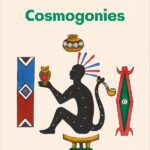 His work was also shown at the exhibition Cosmogonies at the Cobra Museum.
Material memory
Colonialism resulted in the loss of much of Africa’s cultural heritage and related material and technological knowledge. This made it impossible to pass on this knowledge to subsequent generations. For contemporary artists in Africa and the diaspora, materiality is important in their work. In the West this is conveniently called recycling. For these artists, there is no recycling; instead, it is important to them that the objects retain a certain memory and power that is not lost. They mix historical with contemporary objects and elements, creating a visual language that embraces both the past and the present. In doing so, these artists affirm their cultural heritage while questioning the legacy of colonialism.
 This artist is known for his immersive, colourful installations of woven and dyed textiles. He incorporates the world’s major social issues into his art, using the aesthetics and traditional craftsmanship of Mali. In Africa, textiles are also a means of communication.
Abdoulaye Konate was born in the town of Diré in northern Mali. He grew up in an intellectual household. He graduated in painting from the National Institute of Arts in Bamako (1972-1976) and lived in Cuba between 1978 and 1985 to continue his artistic training at the Higher Institute of Plastic Arts in Havana, where he was introduced to a multidisciplinary approach to art that has remained with him to this day.
 Viktor Ehikhamenor is a Nigerian-American multidisciplinary visual artist and writer known for his vibrant and incisive work that engages with African cultural heritage, its resonance within the global African diaspora, and the postcolonial politics of his native Nigeria. The materials and iconography of his work embrace local traditions and the history of Nigeria.
In Leiden, I saw his work ‘Rosaries’ which aims to make us aware of the impact of colonialism on daily life in Benin. Catholicism, introduced by colonial powers, had a profound impact on local communities. In the 16th century, Portuguese missionaries founded Catholic churches in the kingdom of Benin, in what is now Edo, Nigeria. This created a unique blend of Christian and traditional rituals, a fusion of two different religions. Ehikhamenor noticed that despite the large number of African Christians, there were no black saints. So he decided to create them himself, using rosaries. The plastic rosaries symbolise the dark side of good mass production, a consequence of globalisation and colonialism that combines environmental destruction with the loss of local identity.
 This Senegalese artist/ceramist creates sculptures that evoke human-animal hybrids from another world. For her, they are divine beings who reveal themselves to her through visions and dreams. She often depicts pregnant women or mothers carrying their children.
 Everyday events also feature in her work. The sculptures are fired on an open wood fire in the garden outside her house. After firing, she immerses the sculptures in a liquid made from the rotten pods of a local tree. This final stage gives the sculptures their colour and robust texture.
Her mother taught her certain local crafts, but Seyni Awa Camara’s work is based on her own experiences and experiments with ceramics, and she has developed her own distinctive visual language and signature. Her work was also shown at the exhibition Cosmogonies at the Cobra Museum.
Cosmic connections
For many African artists, spirituality is inseparable from their art. The artworks on display in Leiden challenge the Eurocentric belief that African cosmology is ‘primitive’ or superstitious. The artworks depict mythical elements, altars and spiritual beings, reflecting the artists’ deep connection to local and Afro-diasporic spiritual systems.
Art has always played an important role in the practice of spirituality, with artists creating works – sculptures, masks, textiles, music – that enabled communication with the spirit world or represented spiritual beings. Contemporary artists use new techniques and approaches to express their spiritual beliefs and ideas. Spirituality connects them to their communities, but is also used as a means to address issues such as gender norms and colonialism.
Johnson Eziefula’s earliest influences for his art were illustrations in works of canonical African literature such as ‘Chinua Achebe’s Things Fall Apart’, ‘Chike & the River’ and various anthologies of African poetry. He is a self-described naturalist painter who seeks to capture the essence of the human condition. Blurring the lines between figuration and expressionism, his work explores themes of identity, cultural hybridity and the human psyche. Eziefula has created a dark, monochromatic painterly style of his subjects that has become a signature of his work. In 2021, he graduated from the University of Lagos, Nigeria, with a bachelor’s degree in pharmacy.
 For the exhibition in Leiden, Johnson Eziefula created the painting ‘Birth of the Self’. This painting shows the profound influence of colonialism on the African psyche and contemporary African identity. The central theme is the identity crisis faced by a significant part of the African population, both on the continent and in the diaspora.
The painting depicts a man standing indecisively at a crossroad, aware that his life’s path is about to change irrevocably. A blackbird sitting on the man’s shoulders acts as a messenger, alluding to ancestral ties and the Igbo and Yoruba cultures of West Africa.
In his hand, the man holds the symbol of the Catholic faith, representing the tug between two religious traditions, a crucial factor in shaping identity: the widespread influence of Christianity and the traditional religion of the ancestors. A shift is taking place in which people are gradually reclaiming their ancestral religious practices while embracing faiths such as Christianity and Islam. This painting aims to spark conversations about the impact of colonialism on the African identity, and also offers a glimmer of hope.
Wonderbuhle creates portraits of black bodies in calm and meditative poses, rendered in charcoal and acrylic against flat fields of colour. They take their place on the canvas with confidence, as if they know they are allowed to be there. WonderBuhle reflects on the world as a black man from South Africa, a country that is rewriting its history. He wants to make black people aware of their history and their potential.
 This portrait is of his grandmother. She was a great influence on him and not only raised him, but passed on the knowledge and stories of his ancestors. A recurring symbol in his work is the golden native flower, the Impepho, a sage flower used in Zulu culture to communicate with the ancestors. The flower is also used to cleanse a room of evil spirits or to cleanse one’s body. The use of the Impepho flower in the work shows a deep connection to his community.
Born in South Africa in 1989, Wonderbuhle is a Durban-based visual artist from Kwa-Ngcolosi, a village still ruled by a chief. He began making art as a hobby at the age of nine. He received his first formal training through the BAT Centre Artists in Residency (AIR) Programme and went on to study fine arts at the Velobala Apprenticeship Programme at the Durban University of Technology.
Reclamation
Reclamation and restitution have dominated public debate for years. Questions of ownership of colonial heritage and the exposure of colonial systems still present in contemporary Africa are central to this debate. Artists are engaged in new reconstructions of the past, shifting the conversation towards healing and restoration. With an understanding of the complex legacies of colonisation, the artists in this part of the exhibition confront post-colonial histories. They address issues of reparation, restitution, power and exploitation, contributing to the healing of cultural wounds and creating space for new beginnings.
Sammy Baloji was born on 29 December 1978 in Lubumbashi (a city that owes its growth to mining). He studied literature and human sciences at the University of Lubumbashi. After his studies, he started working as a cartoonist. He later specialised in video art and photography. Much of his work is based in his own province of Katanga. The recurring themes in his work are ethnographic exploitation, architecture and urbanism, such as the exploitation of people and the environment in the Congolese urban landscape.
 On display in Leiden were photographs from his ‘Mémoire’ series, taken during the decline of the copper mines. He makes panoramic collages that combine the battered industrial landscape with archive images.
These archival images were part of a propaganda strategy to show how European colonial technology and bureaucracy had helped the country and its people move forward. He uses these historical images of Congolese workers and colonial administrators and overseers to tell a different story about the destructive impact of colonial exploitation. In doing so, he disrupts an idealised image of the colonial past.
Sammy Baloji uses various strategies to link colonial history with the experience of life in Central Africa. The region has a long history of oppression dating back to the Belgian occupation, during which the Congolese were brutally forced to extract natural resources. At the same time, a new generation of Congolese is trying to shape their future. There is now a new rush for rare earths such as lithium and coltan. The artist also co-founded the Lubumbashi Biennale with Gulda el Magambo Bin Ali in 2008, with the intention of making art more accessible in the region, as there were only a few resources for it at the time.
His work was also shown at the exhibition Cosmogonies at the Cobra Museum.
 The ‘All power to the people’ section of the Leiden exhibition already featured work by Ibrahim Mahama, which I wrote about above. In this part of the exhibition ‘Reclamation’, the installation with the collage ‘Voli-ni’, the desks ‘Oil in my head I and II’ and bats ‘Genesis, 2015-2013’. Ibrahim Mahama is a master of creative reuse: architecture, furniture, faded files, maps and antique equipment. He uses this cultural and historical material to explore themes of resources, labour, economics and globalisation.
 Nkrumah Volini grain silo – the installation shown in Leiden is part of a larger project that uses the Nkrumah Volini grain silo to explore Ghana’s post-colonial past. Nkrumah Volini is one of many modernist concrete silos built in Ghana after independence to store grain and other foodstuffs. Abandoned in 1966 and when it was purchased in 2021 it was home to an ecosystem of fish, reptiles, birds and a large colony of bats.
Driven by an interest in how time has solidified in this building, Mahama photographs and researches the silo, which he is currently transforming into a cultural centre. For Mahama, the silo represents the unfulfilled promise of economic freedom after independence in the 1950s and 1960s. Using the collage technique, Mahama visualises the consequences of colonial rule: erasure, destruction and appropriation. The technique embodies the many problematic aspects of Ghana’s past.
His work was also shown at the exhibition Cosmogonies at the Cobra Museum.
 At the end of the exhibition is the art of Tshibumba Kanda-Matulu. It is a selection of 30 art pieces. They show his vision of Congolese history from pre-colonial times to the mid-1970s. The paintings show an unique local perspective. It is not based on facts, but it is an interpretation of memory and political reality.
Matulu’s style was part of a movement called the Zaire School of Popular Painting. They were mainly self-taught artists who introduced the use of bright colours and text on canvas to make strong political statements, especially about the colonial past of Zaire (now the Democratic Republic of Congo). They used techniques we associate with posters, street art and billboards, and their paintings are clearly aimed at the local population.
Matulu’s last known painting dates from 1981. No one outside the Congo has heard from him since. He was presumably killed during unrest.
If you want to know more, the website of the World Museum in Leiden has 3 videos of guest curator Azu Nwagbogu talking about the various artists and their works in the exhibition.
Johanna
