
Wars
Despite progress, the world has not become a better place by 2025. Destruction, oppression and war are as old as humanity itself. It seems as if we have become almost immune to them. Images of conflict flood into our lives every day via TV, photos in newspapers and magazines, and of course social media. I once looked up how many wars had taken place in the world during my lifetime. Globally, there have been around 14.
 I grew up with the trauma that my parents experienced during the Second World War (1939–1945). The impact on my father was enormous due to his experiences as a conscripted soldier in Indonesia. From 1939 to 1945, Indonesia fought for independence from the Netherlands.
Consequently, war, oppression, poverty and resistance were important topics of conversation in our family.
Women on the front line
As previous blogs have shown, I am very interested in photography. So, when I heard that the Fotomuseum in The Hague was hosting an exhibition of Female War Photographers I knew I had to see it.
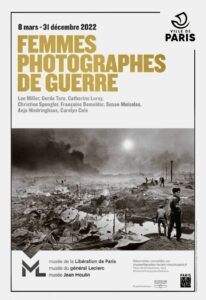 The exhibition was previously on display at the Kunstpalast Düsseldorf, the Winterthur Museum of Photography and the Muséé de la Liberation in Paris.
Some 140 images shot between 1936 and 2011 were displayed. They were taken by Carolyn Cole (born 1961), Francoise Demulder (1947-2008), Catherine Leroy (1944-2006), Susan Meiselas (born 1948), Lee Miller (1907-1977), Anja Niederinghaus (1965-2014), Christine Spengler (born 1945), and Gerda Taro (1910-1937).
These photographs show the reality of war from the Spanish Civil War, World War II, the Vietnam War, the conflicts in the Balkans, Afghanistan, Iraq, and Libya.
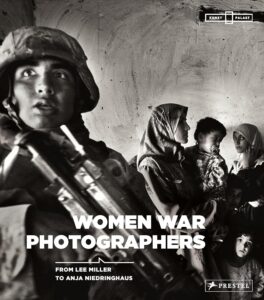 According to the exhibition’s curator, one of the reasons for holding this exhibition was to challenge the cliché that war photographers are always men. The female photographers featured in the exhibition have won awards for their reportage and courage. Although their work has been published in major international magazines and newspapers, according to the curator, their names have not gone down in the history of photography. She hopes that this exhibition will contribute to the women being added to it.
Questions
During my visit to the exhibition, I was very impressed by the photos and the suffering they depicted. I wondered whether this was because I knew the photos had been taken by female photographers, as this was emphasised quite strongly in reviews in various newspapers. An article in the NRC asked the question: ‘Do women show war from a different perspective than men?’ Ultimately, it concluded that the exhibition should focus primarily on the questions and discomfort that the images evoke in us, regardless of the gender of the photographer.
A review in De Volkskrant newspaper revealed that the Fotomuseum in The Hague intended to use this exhibition to challenge the idea that war photography is exclusively a male domain. De Volkskrant concluded that one thing was clear: ‘female photographers take the same risks as men.’
The experts
As mentioned above, the curators of the exhibition placed considerable emphasis on the photographers’ ‘female perspective’ and, in this context, quoted philosopher and writer Susan Sontag (1933–2004) in her essay ‘Regarding the Pain of Others’ (2003). I read this essay (see pdf). I have extracted some key phrases: ‘Is war a man’s game?’ and ‘Does the killing machine have a gender?’
In her essay, Sontag refers to Simone Weil (1909–1943), a French philosopher, mystic and political activist. In 1940, Weil wrote ‘Reflections on War’ (see pdf). However, Susan Sontag specifically refers to Simone Weil’s essay, ‘The Iliad, or the Poem of Force’, in which Weil concludes that ‘Violence dehumanizes both the victim and the perpetrator. Violence turns everyone exposed to it into a thing.’
 I believe she meant that violence robs a person of their capacity for reflection and justice, reducing them to an object, and in the most extreme cases, a corpse.
This reifying power also affects the perpetrators of the violence, turning them into a ‘thing’ as well. She used Homer’s ‘Iliad’ as an example of this phenomenon.
 Simone Weil mentions Ernst Friedrich, who published his influential anti-war book ‘Krieg dem Kriege’ (War Against War) in 1924, a work that used graphic photographs to expose the horrors of the First World War.
This publication was important because of its timing, namely in the year of the commemorative demonstrations in Germany, and because it was published in several languages to reach a wider audience.
I have looked at the publication and the photos are terrible to look at. Especially the section ‘the face of war’ with close-ups of soldiers with enormous facial wounds. Ernst Friedrich hoped that if the horror could be depicted vividly enough, most people would finally realize the scandalousness, the madness of war.
Accustomed?
 We have become accustomed to disasters in other countries entering our living rooms, because it is, after all, news. The Spanish Civil War (1936–1939) was the first war to be documented by a group of professional photographers on the front lines and in the cities that were bombed (Gerda Taro is featured in this exhibition). These photos were published in Spanish and international newspapers and magazines.
Photojournalism flourished at the beginning of the Second World War (1939–1945). This gave photojournalists legitimacy. This was followed by the Vietnam War (1955–1975), the first war to be broadcast daily on television. Since then, non-stop footage has become an almost daily routine.
According to Susan Sontag, we remember still images better than moving images. This is why photographs have a deeper impact. She refers to them as quotations, maxims or proverbs. They are stored in the mind and can be recalled at any time. As cameras became easier to use, photographs surpassed the written word in terms of their impact, immediacy and authority. She argues that photographs are objective records of reality.
 Susan Sontag also argues that people wanted photographs of atrocities to be shown without any form of artistry because this was (and still is) equated with insincerity or mere artifice.
But the exhibition features also photographs taken by Lee Miller. Her photographs demonstrate her attention to composition.
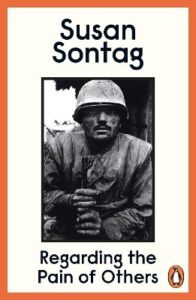 According to the exhibition’s curator, Susan Sontag’s essay reflects on how we, as viewers, should relate to the sight of other people’s suffering. Sontag argues that it takes considerable stoicism to endure the suffering shown on the news every day.
At the same time, she notes that it is precisely this endless exposure to images of suffering that ultimately causes us to become desensitized, so that in the end they often fail to move us, or move us only slightly.
What is my conclusion?
I gathered all kinds of information about the exhibition and, after much effort, managed to obtain the catalogue. Unfortunately, I haven’t been able to write much in this blog about the most important aspect: the female war photographers featured in the exhibition. I will write about that in a separate blog post.
I have great respect for the courage of these female war photographers. They all wanted to go to the front. They had to fight for recognition in the field of journalism and had to work twice as hard to get their images published in newspapers. Three of them are still active: Carolyn Cole, Christine Spengler and Susan Meiselas. The others have passed away.
I don’t really have a clear answer as to whether female war photographers see things differently to male war photographers. Women and men have different social roles, and at the beginning of the 20th century, there was certainly unequal treatment in both the art world and wider society. Nevertheless, these women recount the horrors of war in their own distinctive way. Their photographs offer intimate glimpses of everyday life during wartime, bear witness to atrocities and highlight the absurdity of war and its dire consequences.
 If you like to hear more about this exposition, Marcel Prust made a podcast about the exhibition and this podcast can be listened to on Spotify via this url. He discusses the impact of war photography, its objectivity and who is responsible for it.
For more information about the Women War Photographers, read my next blog post. Johanna, 20 November 2025
