
Pioneers – Gerda Taro
Not only have female war photographers captured images that reveal the world, they have also broken down centuries-old barriers in a male-dominated field. This spans from 19th-century pioneers to contemporary correspondents in conflict zones.
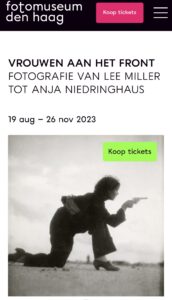
In my blog, I wrote an introduction to the ‘Women on the Front Line’ exhibition, which was held at the Photomuseum in The Hague. The blog mainly focused on whether it was clear from the photos whether they had been taken by women. I have not yet discussed the female war photographers featured in the exhibition. I will now address this. As the photographers worked in different periods, I have organized the blog posts by period and context. This makes it clearer how their position and working methods changed over time while their motivations remained constant.
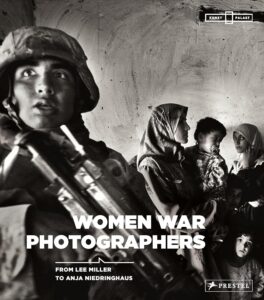 All of these female war photographers had to work hard to gain recognition in the field of journalism. They all made an invaluable contribution to war reporting by showing what was really happening on and behind the battlefield. They went to great lengths for their profession, sometimes paying a high price for it — sometimes with their lives. Many of them struggled with post-traumatic stress disorder after their assignments.
Pioneers (1851–1936)
In the second half of the 19th century, photography was still in its infancy and undergoing rapid development. There were plenty of opportunities for experimentation as there were no established rules. Women opened studios and travelled widely. Many of these women were scientifically trained and used photography to record their research results.
Imogen Cunningham was one of these pioneers. In 1907, she wrote her dissertation, ‘The Scientific Development of Photography’, and in 1913, she published the article ‘Photography as a Profession for Women’ in Pi Beta Phi.
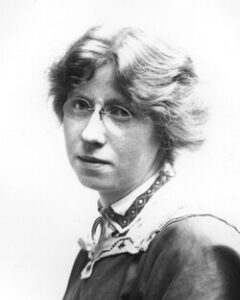 In it, she encouraged women to pursue careers in photography and other professions. Her message was not that they should surpass men, but that they should do something for themselves.
During the ‘Pictorialism’ movement, women began to establish photography as an art form. They experimented with unconventional viewpoints and transitioned from the soft, dreamy style of ‘Pictorialism’ to a more realistic approach.
Some photographers employed surrealist techniques such as solarization (which involves a decrease in optical coverage of the image due to heavy overexposure), and photograms (which are camera less images created by placing objects directly on light-sensitive paper to produce abstract silhouettes). They were part of the ‘New Vision’ movement, exploring cities in search of unique viewpoints and later often switching to documentary photography, thanks to their innovative vision and unique perspectives.
Was Gerda Taro the ‘pioneer’ of female war photography?
 Although the term ‘pioneer’ usually refers to the earliest female photographers, I consider her to be the pioneer of war photography. She took poignant, direct images on the front line, breaking boundaries and discovering new perspectives that have inspired generations of female war photographers. (Note: although Gerda Taro is not mentioned under ‘Pioneers’ in the Thames & Hudson classification, I believe she belongs here due to the period during which she worked as a war photographer, her methods, and her influence.)
Who was Gerda Taro?
 Gerda Taro (born Gerta Pohorylle) was born in Stuttgart in 1910. Her parents were Jewish immigrants. She studied in Stuttgart, Lausanne and Leipzig. Due to her political activism within the German Communist Party (and her opposition to the Nazis), she was forced to flee.
In Paris, she came into contact with other emigrated intellectuals and artists, and met the Jewish Hungarian photojournalist Robert Capa (André Friedmann). The couple changed their names to Gerda Taro and Robert Capa. She became an assistant at the Alliance Photo agency, where she broadened her photographic knowledge and expanded her network. Robert Capa became very well known, and initially, because of his fame, photos taken by Gerda Taro were published under his name.
The Spanish Civil War
 When the Spanish Civil War broke out in July 1936, Taro and Capa chose to cover it. They hoped that this would contribute to the resistance against fascism. They went to Barcelona on assignment for the magazine ‘Vu’. ‘Vu’ was the first major weekly magazine to systematically publish photographs in essay form.
In the 1937 issue of the Communist weekly magazine ‘Regards’, this changed to Capa and Taro. In 1937, Gerda Taro received her first official assignment from the French Communist Party’s daily newspaper ‘Ce Soir’, founded in exile in March 1937. Shortly afterwards, one of her photos appeared on the cover of the German magazine ‘Volks-Illustrierte’, also published in exile.
 Gerda Taro’s photographs of the Spanish Civil War received increasing attention due to the great interest in the conflict. Her work is characterized by her direct involvement and empathy, and she took risks to tell the stories of ‘ordinary people’ in wartime. Tragically, she was the first female war photographer to die on the battlefield in July 1937. While her death received international attention, her photographs did not receive the recognition they deserved, partly because photo agencies at the time attributed her work to Robert Capa. It was not until the beginning of the 21st century that her dedication and work were rediscovered.
What do I think of Gerda Taro’s photos?
It is almost 100 years ago she took her photos in bizarre circumstances. Driven by her ideals and convictions, she used her photography to fight against fascism. Her social commitment and attention to human suffering are evident in all her photographs. She photographed female resistance fighters, battlefields, the dead, refugees and the destruction caused by bombing — in short, everything related to war. No matter how intense the situation, she always chose a beautiful vantage point from which to capture the scene.
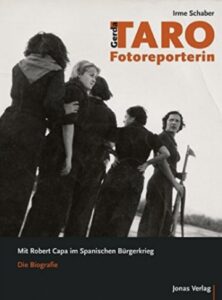 As I described above, during the ‘Pioneer’ period (1851–1936), women were encouraged by other women to pursue careers in photography and other professions. The aim was not to surpass men, but to empower women to achieve something for themselves. Gerda Taro was fortunate to be able to practice her profession on an equal footing with Robert Capa, learning from each other and shaping their shared ideals. They must have encouraged and inspired each other.
 In 1947, Robert Capa co-founded Magnum Photos, an agency that would give photographers more control over their work and support in documenting the world from a human perspective.
Capa once said, ‘If your photos aren’t good enough, you’re not close enough.’ Looking at Gerda Taro’s photos, I noticed that she always got close to her subjects and captured them from a human perspective. This made me feel as though I were part of the scene, as though I could almost experience what the subjects were going through.
In my next blog post, I will focus on two other female war photographers featured in the exhibition: Lee Miller and Catherine Leroy.
Johanna – 27 November 2025
