
Introduction
War is difficult to understand from a distance. Those who only consult maps, figures and statements can see the strategy, but not the human element. Catherine Leroy chose to bridge that gap. Not to depict heroism, but to stand at the intersection of fear, concern and duty. Armed with her Leica camera, her petite stature and an unwavering focus on the human element, she found herself at the heart of conflicts that shaped the twentieth century. This blog explores her decision to get close up — and what it revealed.

Motivation
Catherine Leroy grew up in a Europe that wanted to look ahead after World War II and leave the recent past behind. There was a collective silence and an unspoken agreement not to dwell on the past. This silence made her sensitive to the hidden consequences of unresolved conflicts. For her, silence was not a sign of peace or reconciliation, but an indication that tensions remained beneath the surface. This realization was an important factor in her decision to document wars first-hand and not shy away from danger by placing herself at the heart of the conflict.


Vietnam and the choice for proximity
The Vietnam War arose from the conflict between the Vietcong, supported by North Vietnam, and the South Vietnamese regime, supported by the United States. That regime was led by Ngô Đình Diệm, a devout Catholic and outspoken anti-communist. While a large part of the population was Buddhist, political power was in Catholic hands and Buddhists were systematically disadvantaged. Protests increased and were harshly suppressed. The country became deeply divided.


It was in this context that Catherine Leroy arrived in Vietnam in 1966. Not as an embedded photographer with American units, but as a freelancer, with her Leica M2, an accreditation for Associated Press (AP), and a strong conviction. She didn’t want to view the war from a safe distance; she wanted to understand the impact of violence on people first-hand. She also knew that she had to stay alert and not allow noise or chaos to overwhelm her. Her position was precarious, but that was precisely where her strength lay: being present without being sensational; vulnerable, yet determined.
Working method

She photographed not only the battlefield, but also field hospitals, bombed villages, improvised roadside funerals and the expressions of soldiers and ‘enemies’. Her approach was centred on intimacy. To her, a conflict could be encapsulated in the torn hem of a shirt or the rust stain left by chemical rain on a tank. She believed that details convey more than panoramas because horror must permeate the everyday to be believable.
Image description: Battle of Hill 881, Khe Sanh (1967)

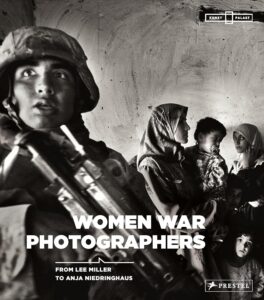
The book ‘Women War Photographers’ contains amongst others two black-and-white photographs depicting this scene. One shows US Navy Medic Vernon Wike kneeling next to a seriously wounded Marine. The sky is grey and the vegetation is low and ragged. The earth still seems warm. I am struck by a feeling of closeness, as if I myself were lying low on the ground.
The photo was taken from a position just below the line of fire. At the bottom of the image, you can see the flattened stems of plants that Catherine Leroy must have pressed down as she crouched as low as possible. The battle is still raging. You can feel it. Wike’s gaze shifts between concern and concentration, duty and awareness of impending loss. In the second photo, Wike is lying on top of the dying soldier’s body in a protective gesture that reveals his grief. Together, the images convey the reality of war: not as an abstract concept, but as something terrible.
The Vietnam War at its Peak

On 27 January 1973, the Paris Peace Accords were signed. These stipulated that North and South Vietnam would be reunited through free elections, and that American forces would have to leave the country. In July 1976, Vietnam was officially reunited.
Years later, Robert McNamara — then US Secretary of Defense and one of the main figures responsible for American involvement — described the war as part of the Cold War, essentially making it a civil war. For photographers such as Catherine Leroy, who witnessed first-hand the consequences of that policy, this political redefinition was hardly relevant. Her images show the impact of war on people, regardless of ideological frameworks.
After the Vietnam War
Catherine Leroy spent three years photographing the Vietnam War up close. In 1969, she returned to Paris, exhausted both physically and mentally. She suffered from severe migraines and post-traumatic stress disorder (PTSD), which manifested itself in sleepless nights. That same year, she photographed the famous Woodstock festival — a moment of collective freedom and utopia — which stood in stark contrast to the violence she had captured in recent years.
In 1975, she returned to Vietnam when news emerged that North Vietnamese troops and National Front for the Liberation of South Vietnam units were advancing on Saigon. The regime was expected to fall soon. Catherine Leroy was present on 30 April 1975 when the first columns entered the city and the war came to an end. Throughout the 1970s and 1980s, she travelled the world documenting wars and other stories in countries such as Northern Ireland, Somalia, Libya, Kenya, Gabon, Afghanistan, Pakistan, Japan and China.

Remarkable
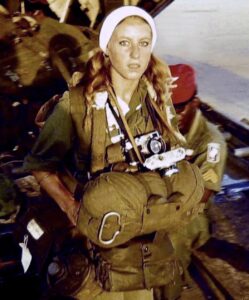
Catherine Leroy was the first woman to have several exceptional military experiences. In 1968, she became the first female photographer to take part in a combat parachute jump, jumping from a height of approximately 4,000 meters over Khe Sanh. Soon afterwards, she was wounded while embedded with a Marine unit in the demilitarized zone. She was also briefly captured by North Vietnamese troops during the Tet Offensive.
Awards
- 1968: George Polk Award for News Photography for her coverage of the Battle of Hill 881 (1967).
- 1976: Robert Capa Gold Medal (first woman) for her coverage of the Lebanese Civil War.
- 1987: NPPA Picture of the Year Award for her coverage of the Tripoli bombings.
- 1997: Honor Award for Distinguished Service in Journalism, University of Missouri.
Books and publications
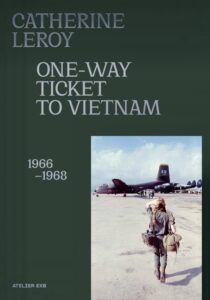
One-Way Ticket to Vietnam (1966–1968): posthumously published book in which Catherine Leroy is both the subject and author. It contains 91 black-and-white photographs, 25 color photographs and approximately 40 documents and personal archival items.

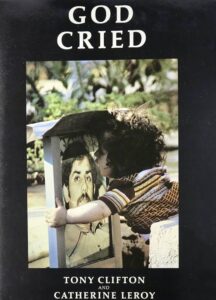
God Cried: Catherine Leroy and journalist Tony Clifton documented the conflicts in Lebanon together, including the siege of Beirut and the Sabra and Shatila massacres.


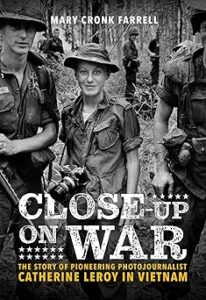
Close-Up on War: The Pioneering Photojournalist Catherine Leroy in Vietnam: by Mary Cronk Farrell. This accessible book is suitable for young people and adults and covers her life and work.
Film and digital projects
Operation Last Patrol (1972): A documentary co-directed with Frank Cavestani about veteran and anti-war activist Ron Kovic.
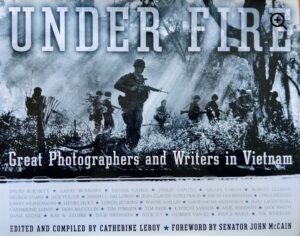
Under Fire: Images from Vietnam (2002): a website featuring the work of leading Vietnam correspondents compiled by Catherine Leroy.
Ultimately
All female war photographers considered themselves journalists first and foremost. They created sensitive, powerful and humane images that transcended their function as news illustrations. Through their sense of composition and timing, they revealed the essence of events without reducing violence to spectacle. Writing this blog about Catherine Leroy was my way of discovering the background, motivation and perseverance of a photographer who ventured into the midst of violence. My admiration for her courage, and for that of all these war photographers, runs deep.
In my next blog post, I will focus on Françoise Demulder. A photographer from a different generation, she had a background in philosophy and also went to Vietnam. She later documented conflicts in Cambodia, Angola, Lebanon and Iraq. Her life and work provide an intriguing continuation of the question central to both her and Catherine Leroy: what does it mean to look and be seen in the midst of war?
Johanna, 22 December 2025


