
Introduction

Off to Vietnam on a whim!
Like Catherine Leroy, Françoise Demulder left for Vietnam in the early 1970s on a whim. She had no formal training or experience as a photographer. Together with her partner at the time, Yves Billy, she travelled to Southeast Asia. She financed her travels by doing a variety of odd jobs, from modelling to proofreading. She had previously studied philosophy, a background that would later influence her perspective.
Once in Vietnam, she started taking photographs to earn a living. There was high demand for images from the war zone, and she managed to sell several of her photographs to press agencies a day. In a recent interview, Yves Billy confirmed that, for her, photography was not a romantic choice, but a means of survival. It was war, and images were currency.


Françoise Demulders’ career emerged from this context of necessity and determination, without planning or preparation.
Contemporaries
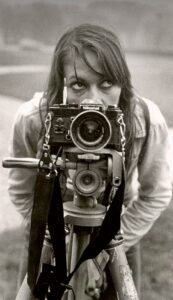

All three female war photographers were self-taught. Françoise Demulder quickly learned the basic principles of war photography: having strong nerves and being in the right place at the right time. She also developed a unique visual language. Many of her photographs captivated viewers with their remarkable tranquillity, sense of distance, and clearly structured compositions.
Thames & Hudson: classification by generation


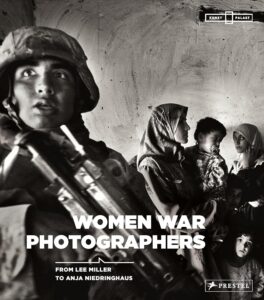
This choice becomes more understandable when you look at the criteria. Thames & Hudson defines the pioneering period as a phase in which women emancipated themselves, travelled independently, created their own professional spaces and gained access to fields that were previously mainly dominated by men. Catherine Leroy fits that profile, not because her style is directly related to the earliest photographic avant-garde, but because she asserted her right to be present in a war zone — a world that did not expect her there.
A new era
From the 1970s onwards, photography underwent a fundamental change in status. The medium gained a permanent place in museums, academies, and cultural institutions. Photographs were included in collections, and specialist courses, professorships, curatorships and critical theory emerged. Photography was no longer exclusively seen as a means of documentation; it was also recognised as an autonomous art form and a valuable research tool.


Yet even during this period, attention remained primarily focused on male photographers. It was only through emancipation movements, activism and debate — often initiated by female photographers — that assumptions about gender and (war) photography gradually came to light. Traditional ideas about authority, authorship and legitimacy within the profession were gradually analysed and criticised.
A ‘world first’ in Saigon
On 30 April 1975, while virtually all Americans and other foreigners were being evacuated from the city, Françoise Demulder decided to stay. From the presidential palace, she witnessed North Vietnamese tanks rolling into the city, which marked the end of the war in South Vietnam. She was the only photographer present. Her photograph was published worldwide and became an iconic image of American defeat.
World Press Photo
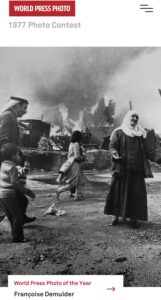

In 1977, Françoise Demulder became the first woman to win the World Press Photo Award. Her award-winning photograph, taken in Beirut on 18 January 1976, shows an elderly Palestinian woman begging a Christian militiaman for mercy while children and other local residents flee barefoot from the still-smouldering Karantina neighbourhood following the previous night’s massacre.
The power of this image lies not in sensationalism, but in the distance between the photographer and her subject: Françoise Demulder stands just far enough away not to disturb the scene, yet close enough to convey the intensity of the situation.
This photograph is an iconic photograph because it is more than just a visual record. It carries an emotional impact: fear, supplication and powerlessness. It has stood the test of time, remaining recognisable and becoming part of the visual history of the 20th century.
A life on the front line
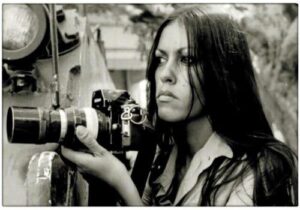

Her photographs were published in Paris Match, Time, Life, Newsweek, British Sunday supplements, French and German magazines such as Stern.
Final years and legacy
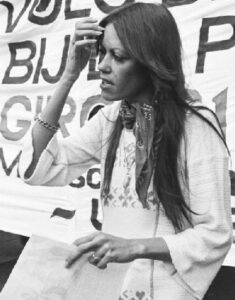

Françoise Demulder Photography Grants
Since 2020, the French Ministry of Culture and Visa pour l’Image – Perpignan have awarded the Françoise Demulder Photography Grants annually. The grants are intended for active female photojournalists documenting social, economic, political or cultural subjects. Two winners will each receive €8,000 to complete or realise their reportage.
Françoise Demulder once said that ‘she hated war, but felt compelled to show that it is always the innocent who suffer while the powerful grow richer’. I share that sentiment and admire her, as well as all those who continued to look where others looked away. If you would like to see more of her photos, please visit this website.
Preview
Would you like to read more about the female war photographers who were featured in the ‘Women on the Front Line’ exhibition? My next blog post will focus on Christine Spengler, whose work primarily centred on the daily lives of women and children in bombed cities, as well as the lasting impact of war.
Johanna, 4 January 2026


