
“The laws of color are unutterably wonderful, precisely because they are not accidental.” Vincent van Gogh
Where It Began
My journey into the world of graphic art began in 1991, some thirty-five years ago, at the TEFAF Maastricht art fair. Amidst an overwhelming display of thousands of artworks, we bought a print by the Ukrainian artist Gennady Pugachevsky. What started as a chance purchase grew into a true friendship through our correspondence. It was this friendship that eventually brought me to Kyiv twice—once in the summer and once in the winter.
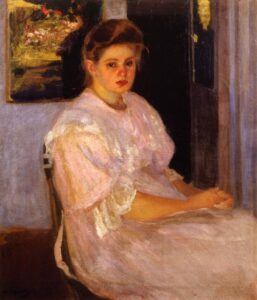
During my stay in Kyiv, Gennady Pugachevsky and his friend Konstantin Antioukhin took me to the National Art Museum of Ukraine. There, I was captivated by something that has never let me go since: the luminous pink tones in the paintings of Oleksandr Murashko (1875–1919).
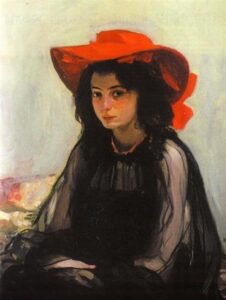

Where did that striking, deeply innovative color—so unprecedented for that region—come from? The answer lies in Murashko’s travels abroad. Around 1901, he traveled on a scholarship to Paris and Munich. There, in the beating heart of the European avant-garde, he was profoundly inspired by French Impressionism and the bold use of color by the early modernists. He left the academic rules of his formal training behind, and through his use of intense, warm hues, he brought the Parisian experiments with light back to Kyiv.
The memory of that shade of pink set me off on a quest to understand what color truly is. Is it pure matter from a jar of paint, or a psychological illusion of our brain?
Transparency and Contrast
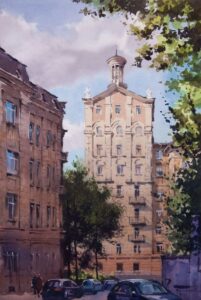

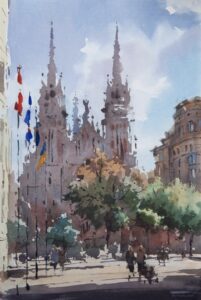

Today, my Ukrainian friends continue to make that interplay of color tangible, each within their own discipline. Gennady Pugachevsky still lives in Kyiv and now creates wonderful watercolors (which can be seen on his Instagram account).
In watercolor painting, you do not merely mix colors on a palette; you weave them onto the paper in wafer-thin, transparent layers. Because the paint is translucent, the white of the paper itself plays a vital role in creating light, intensity, and brilliance.
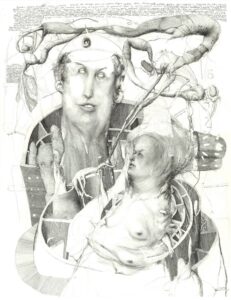



Konstantin Antioukhin, now working from Spain, pushes the boundaries in a completely different way through his black-and-white etchings (also visible on his Instagram account). Although his work contains no color, its foundation is indispensable. Black and white are, after all, the conductors of the color palette: one absorbs all light, while the other reflects it entirely. By playing with a rich gradation of deep inked lines, he achieves the ultimate contrast between light and dark.
The Pigment
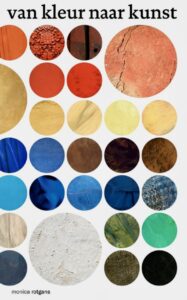

On the other end of the spectrum, she dissects the blacks—from charcoal and lampblack to bone black and complex composite variants. Yet her book is about far more than black and white; she unravels the chemistry behind the entire color spectrum. She demonstrates that color is shaped by particle size and the origins of minerals and organisms, and how these together determine the way paint reflects light.
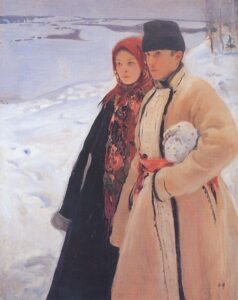

Yet recent scientific research into Oleksandr Murashko’s paintings reveals that his signature pink was not owed to a single pigment, but rather to a clever innovation in his painting technique after 1905.


He began preparing his canvases himself with a ground layer based on calcium sulfate, creating a brighter, more absorbent surface that allowed light colors to radiate. In addition, he gradually transitioned from warm lead white to the cooler, more transparent zinc white. By mixing this zinc white with vermilion, natural madder lake, and the then-modern synthetic alizarin crimson, he was able to conjure subtle, luminous pink reflections onto the canvas.

The Gift
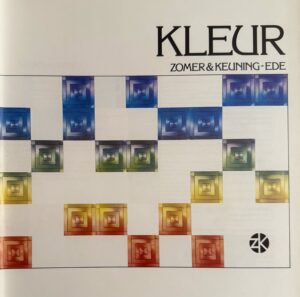
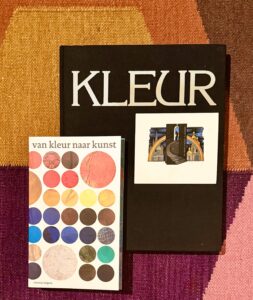
When I told one of my friends, Frans Vermeulen, that I was writing a blog post about this quest and the soul of pigment, he pulled a wonderful, fitting book from his own shelves and gifted it to me: Colour (originally published by Marshall Editions in London, and released in the Netherlands by Zomer & Keuning in 1981).

My Love for Color

Grateful
When I look back on my path through the art world—a journey that, as far as graphic art is concerned, began at that fair in Maastricht and has led me via museums in Kyiv to the street art and graffiti walls of today—it fills me with genuine joy. I feel privileged to have experienced so many different facets of art throughout my life. It continues to inspire me how artists, with intense passion and under all kinds of circumstances, keep creating their work and commit themselves unconditionally to what they hold dear. To me, that is the true magic of art.
But what happens when color is not merely tangible matter, but also plays tricks on our eyes and brain? In my next blog post, The Deception of the Eye, I will dive deeper into that fascinating game of optical illusion.
Johanna


