
The temptation of the Perfect Picture




The Afropolitan Must Go
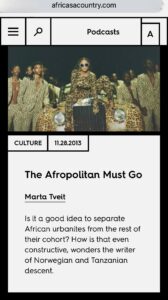

In her powerful essay “The Afropolitan Must Go” , she extends Wainaina’s line of thought directly to our modern Western consumer culture. She simply refuses to be placed in such a super-modern box; she writes that she feels no ‘spiritual drum’ beating inside her and she is quite ambivalent toward jazz. With this, she holds a razor-sharp mirror up to people like me — white, Western, a baby boomer. Because how eagerly do we embrace the modern, glamorous ‘Afropolitan’ style, simply because it feels comfortable!
Success on Own Terms
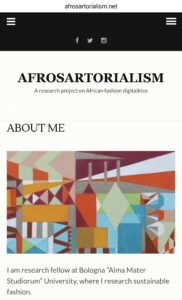

I found another perspective in the work of Dr. Enrica Picarelli, an Italian cultural researcher and fashion sociologist connected to the University of Bologna. She specializes in postcolonial studies and founded the platform Afrosartorialism, through which she explores how young African makers tell their own visual stories via fashion and street culture.
Picarelli refuses to think in black-and-white terms. According to her, there does not have to be a contradiction when an important political or cultural narrative is packaged within a successful fashion brand. For young designers and artists, that market is precisely a way to claim their own space and be taken seriously. Selling streetwear or artworks grants these creators financial independence and a global stage. Her analysis demonstrates that commercial success does not have to compromise the creator’s own identity or their deeper message.
What about the Netherlands?
This principle — that commercial success does not have to compromise the deeper message — becomes even more concrete in the work of Dutch anthropologist Marleen de Witte. She conducted research into Afro-Dutch youth and their engagement with style and cultural heritage. She makes it clear that Marta Tveit’s warning about consumption (that we should not treat Black culture merely as a fashionable lifestyle brand) plays out a bit differently in Dutch 

What might seem like ‘commercial consumption’ to outsiders is, according to De Witte, a way for these Black creators in the Netherlands to be valued on their own terms. In a society that likes to call itself ‘colorblind’, these young people use their international, proud style to claim space within a predominantly white culture. Their message is clear: “We belong here, we are successful, and we define our own identity.”
Patta and Daily Paper: Impact
Two perfect examples of what Marleen de Witte describes are the Amsterdam streetwear brands Patta and Daily Paper. Patta was founded by Edson Sabajo and Guillaume ‘Gee’ Schmidt, who both have Surinamese roots. What started for them as importing exclusive sneakers grew into a global phenomenon that collaborates with giants like Nike.
From the outside, this success might seem like purely capitalist marketing success, but anyone who looks deeper will see the value and recognition that De Witte is referring to. For both founders, everything revolves around culture and building a community, not around marketing. In a predominantly white fashion world, Patta showcases a realistic, diverse street scene and offers a home to young people who do not feel heard elsewhere.


Their influence now even reaches the world stage: Patta designed the official Dutch World Cup shirt for the 2026 football world championship. This shows that a streetwear brand can simultaneously be displayed in a museum, featured at a World Cup, and still simply maintain its credibility on the street.
Daily Paper


However, Daily Paper’s approach perfectly illustrates what Marleen de Witte describes. The founders consciously use their commercial success to make an impact. They fund football pitches in Ghana and support local talent to promote a powerful, authentic image of African culture. Here, commerce is not the final destination, but a means to command recognition on their own terms and remain independent.
From Creators to Collectors


This style of collecting holds up a mirror to art enthusiasts. Is this genuine engagement, or is it the ultimate form of Western cultural consumption that Marta Tveit warns against? After all, rapidly snapping up a trendy, colorful collection that is highly marketable can look dangerously like using someone else’s identity to boost one’s own status.
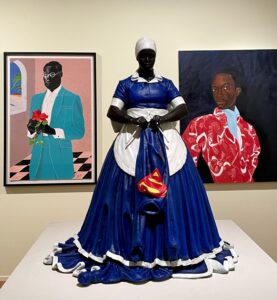



Paradoxically, the market supports them, enabling them to be valued on their own terms (as Enrica Picarelli describes).
My Conclusion: Room for Complexity


I do not have to forcefully cling to a single truth as an outsider.The real gain of this search is that I have accepted that all those different, sometimes contradictory forms are allowed to exist at the same time.
Johanna
P.S. Does art always have to fulfill a social or moral duty to be legitimate, or can it simply be an autonomous form? In my next blog, I’m letting my critical instincts run free and searching for the answer outside established frameworks — on the streets. Will you join me again?


